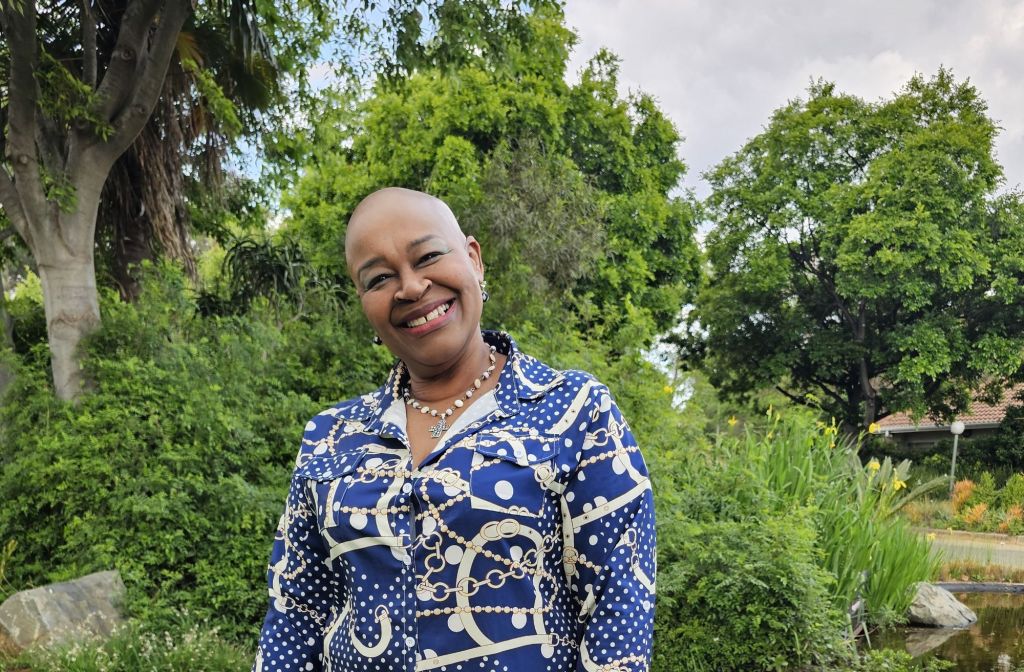

Few people who know the powerhouse that is Ayanda Matthews can picture her as a stay-at-home mom.
But for five years, the woman who is synonymous with Rand Aid Association stayed home to raise her first two children.
Now nearing her November 30 retirement after more than 35 years at Rand Aid, it is still impossible to imagine her homebound.
Asked how long she’d last into retirement without starting a project, she says: “One month.”
Which is just as well, because she has a bucket list and is determined to tick off as many adventures as possible, with a visit to the ancient Inca city of Machu Picchu in Peru at the top.
Apart from travelling as much as she can, she plans to get involved in family businesses, take up photography, join a dance group, garden and look after her ‘beloved grandson’.
A force of nature
With her sparkling eyes, energy and can-do attitude, Ayanda has inspired countless colleagues, staff members and Rand Aid residents.
She has an unusual ability to relate to people from all walks of life and, after years in HR and labour relations, believes that ‘every one of us has something of value to offer’.
That nurturing side stands in stark contrast to the saying she is best known for: “Go suck a lemon.”
She firmly believes in rolling with the punches and getting over things – but she is equally known for her wicked sense of humour. So if Ayanda ever told you to suck a lemon, you could be fairly sure it was either said with a smile or intended as a gentle reminder that life’s complexities call for a bit of tenacity and perseverance.
The phrase ‘larger than life’ may be a cliché, but it applies to Ayanda.
When Rae Brown, who was Rand Aid CEO for almost 15 years until his death in 2019, walked in on his first day, he was met with a sight he would never forget. It was the then-accountant’s birthday, and Ayanda stood proudly on his desk, belting out Happy Birthday. “In typical Rae fashion, he just stood there shaking his head,” recalls Ayanda.
People who left their mark
Rae left a lasting impact on Ayanda. “It didn’t matter what station in life you were at, Rae respected you,” she says.
He was one of five CEOs Ayanda worked with during her Rand Aid career.
Other people who inspired her include a cardiologist who was a client in Rand Aid’s substance use disorder centre; Amanda Diener, a fellow Exco member who has ‘passion and unlimited reserves in doing her job’; and the late Esme Erasmus, who joined Rand Aid in the same year as Ayanda.
“There was still a tangible black and white divide; however, she welcomed me as a fellow professional and bent over backwards whenever there was any unfair treatment meted out to me. Over the years, we became family.”
A career born from circumstance
Ayanda’s own arrival at Rand Aid was almost accidental. She had left the labour ward at Baragwanath Hospital in September 1991, at the height of the HIV epidemic. Many women arrived to give birth without having had prenatal HIV tests. At the time, it was common practice for these women to be left unattended during labour, but Ayanda’s conscience would not allow her to do that.
“I opted to leave without any job prospects,” she says.
Her husband saw an opportunity to turn the unexpected break into a holiday, and the couple went to Port St Johns. When they returned, a note waited under their door, asking her to report to Matron Myles at Rand Aid Association.
On October 7, 1991, Ayanda arrived to meet the matron. “She hired me there and then.”
Her decision to become a nurse had its own deep roots. Her grandmother was a nurse who later became a teacher, while her mother was also a nurse. But the stories her grandmother told about her own experiences as a patient ultimately drew Ayanda to the profession. Her grandmother lost nine babies, with only Ayanda’s mother surviving. Some were stillborn and others died shortly after birth.
“She never spoke of how she felt at losing her babies but would always relate how she was treated by each midwife who assisted her during delivery. Some were not pretty stories and I vowed that if I were ever in a position to have the responsibility of someone’s life in my hands, I would do all in my power to be positively present.”
Ready when opportunity came
Ayanda started at Rand Aid as a professional nurse, but it was not long before she moved into management. She was ambitious, she says, and Rand Aid gave her opportunities to turn that ambition into action.
“I quickly enrolled for a business management diploma as I could see the opportunities and had to be ready when the time came.”
She believes that drive was planted long before she entered the workplace. “I come from a family of achievers and I married a man who was wise and driven himself.”
Her grandfather, Abednigo Jafta, was particularly influential. “He was a man before his time. He positively reinforced hard work, reaping what you sow and success against all odds being the only path to a life worth living.”
At a time when girls were largely groomed for motherhood and marriage, her grandfather asked Ayanda a different question: “What is the goal?”
A changing Rand Aid
Mirroring South African society, Ayanda says Rand Aid has changed enormously since she joined the organisation in 1991 – three years before South Africa became a democracy. “Salaries were based on colour then,” she recalls.
The change has extended beyond employment practices. “Back then, care centres for older people were very hospital-like. The shift towards person-centred, relationship-focused care has been huge. We have realised that Rand Aid is not a retirement village or a frail care centre to our residents – it is their home. We don’t prescribe the care our residents need; we work with them towards a common goal, finding out what matters to each person and supporting them to live the life they want.”
What she leaves behind
When asked what she hopes to leave behind at Rand Aid, she says: “Love and humanness.”
Those who have worked with her would probably add a few more words. Ayanda says the traits her colleagues would recognise most readily are respect for others, sharing knowledge, reliability and keeping confidences. Perhaps surprisingly for someone with such formidable energy, she values inner peace. “I am at peace with the world, no matter what storms are raging.”
If she could give the Ayanda who walked through the gates of Wedge Gardens in 1991 one piece of advice, it would be simple. “Patience. Rome was not built in one day.”
When asked what she would take with her into retirement if she could choose just one thing, she knows exactly what she would choose. “A promise, preferably written, that every person who walks through our gates will be treated as a human being.”